
On July 14, Environment Canada announced a severe thunderstorm watch for New Brunswick, indicating that conditions were ripe for the formation of thunderstorms.
The watch also indicated a potential risk of tornadoes linked to these weather conditions.
Despite the watch, neither severe thunderstorms nor a tornado occurred; however, a flurry of activity on social media followed, resulting in the dissemination of misinformation, questionable images, and widespread panic.
Sander van der Linden, a psychology professor at the University of Cambridge and a specialist in misinformation, noted that extreme weather events, natural disasters, and health crises often attract false information.
“It’s real-time,” he remarked. “There’s urgency and uncertainty, prompting people to attempt to fill in the gaps.”
It is essential to differentiate between an Environment Canada “watch” and a “warning.” A watch alerts individuals to prepare for possible severe weather, while a warning instructs immediate action as severe weather is either occurring or imminent.
On the day the severe thunderstorm watch was issued, Jill Maepea, a meteorologist with Environment Canada based in Fredericton, informed CBC News that the likelihood of a tornado was minimal.
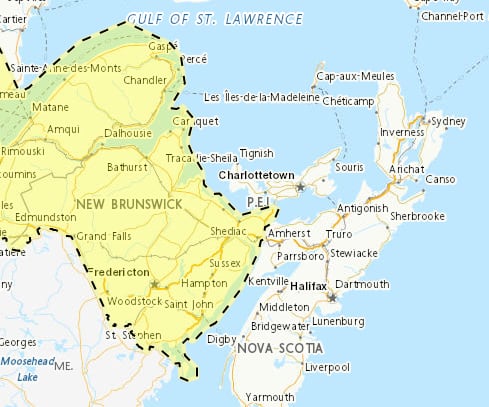
On July 14, severe thunderstorm watches were issued for the entire province, indicating a tornado risk. (Environment and Climate Change Canada)
Nonetheless, prior to the Environment Canada watch, social media users were already expressing concern over the potential severe thunderstorm, with Facebook pages issuing warnings days in advance.
Maepea explained that while meteorologists strive to predict convective storms ahead of time, such weather can evolve rapidly, which differs from the process of monitoring “a large winter storm.”
She added that these storms can also dissipate just as quickly.
“It’s quite challenging to predict and track,” she stated.
Sander van der Linden, a psychology professor at the University of Cambridge, remarked that if a real environmental or public health crisis occurs, individuals may doubt it due to past instances where misinformation obscured the facts. (CBC/Zoom)
Criticism directed at Environment Canada emerged on social media for not issuing a timely alert regarding the storm. Furthermore, even after the watch was posted that morning, misleading posts began circulating, falsely claiming that tornado warnings were active.
However, no tornado warning or watch was ever issued.
Van der Linden acknowledged that while official communication is beneficial, such information can be misinterpreted if individuals do not understand its meaning.
“The initial cautious and scientific message can transform into something quite alarming,” he noted.
After the watches concluded, the uproar on social media persisted. Some individuals expressed frustration over the absence of a storm, while others shared images of a storm that never occurred.
In one instance, an AI-generated image of a funnel cloud in Fredericton was shared on Facebook with an “AI content” label. The post garnered hundreds of shares and comments, with many users pointing out its AI origins.
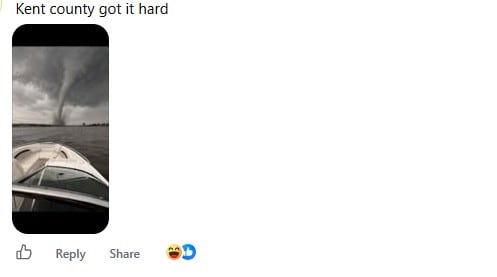
An anonymous Facebook comment about the lack of weather on July 14 included a photo of a waterspout in Kent County that was fabricated. (Facebook)
Another photo, shared by an anonymous user in a Facebook comment, depicted a large waterspout seemingly captured from the bow of a boat, captioned, “Kent county got it hard.”
Additionally, a comment under a post discussing the storm’s unimpressive nature stated that Quebec fared worse, attaching a dramatic tornado image.
While Quebec also had widespread weather alerts on the same day as New Brunswick, the photo claimed to be from Drummondville, Que., but was actually from a deadly EF4 tornado that struck Fairdale, IL., in 2015.
Van der Linden expressed that hyperrealistic AI is complicating the public’s ability to distinguish between real and fake content online. He also mentioned that when someone encounters images of severe weather on social media, their cognition might accept it as genuine, regardless of its realism, due to various influences.
Aaloak Jaswal, who leads innovation at the University of New Brunswick’s Data Science and AI Research Institute, emphasized the need to acknowledge that new communication technologies have facilitated the rapid spread of information. However, he noted that AI has uniquely made it remarkably easy to create “convincing information.”
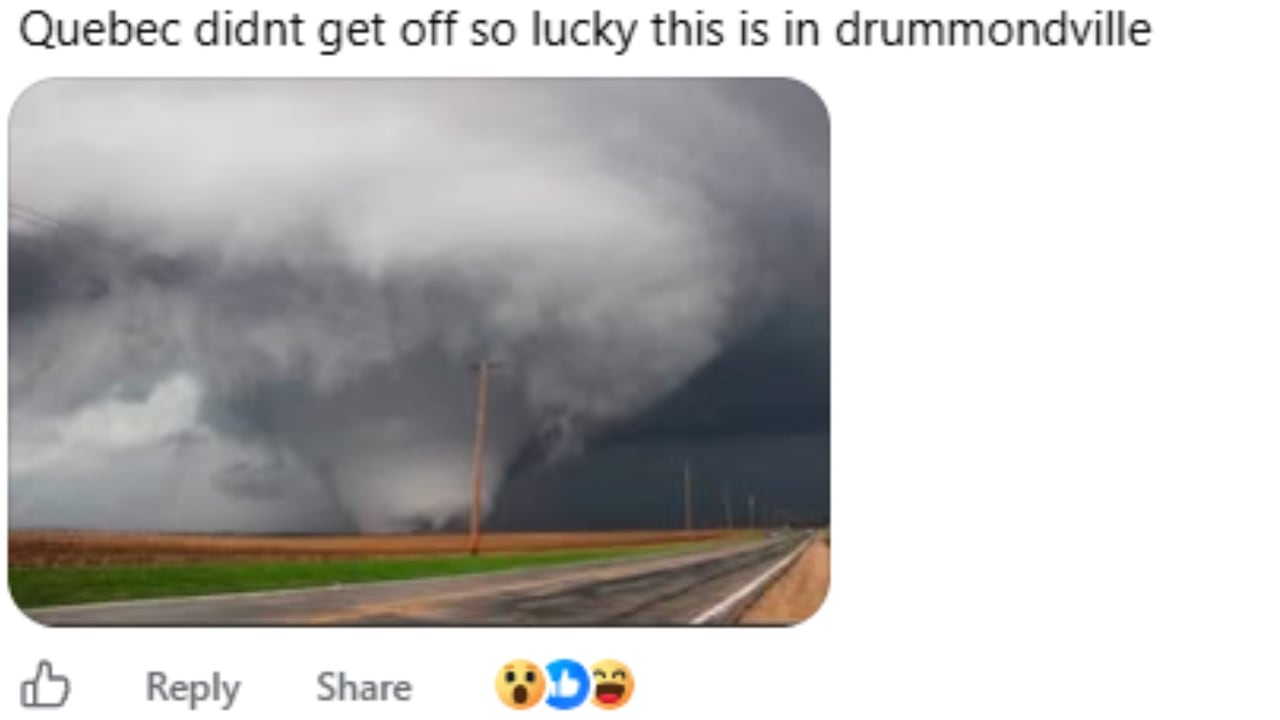
One user shared a photo claiming it was taken in Drummondville, Que., although it was actually captured during a deadly EF4 tornado that struck Fairdale, IL., in 2015. (Facebook)
Jaswal remarked that rumors have always existed, evolving from chain letters to emails to altered photographs.
“AI hasn’t generated misinformation … but it has significantly lowered the entry barrier,” he explained.
“Nowadays, anyone lacking technical skills can simply type a phrase into a free AI tool and create a remarkably realistic image in less than a minute.”
He further stated that he does not believe individuals consciously decide whether an image is real or fake when viewing it, especially during emergencies.
For instance, he noted that if there is circulating information about a possible tornado, and someone sees a tornado image, their immediate response is typically not to question the image’s authenticity, but rather to inquire about the safety of others.
“We are transitioning from a phase where images were once verified to a reality where we increasingly need to validate the source, which I believe is a more sustainable approach as technology continues to advance,” Jaswal stated.
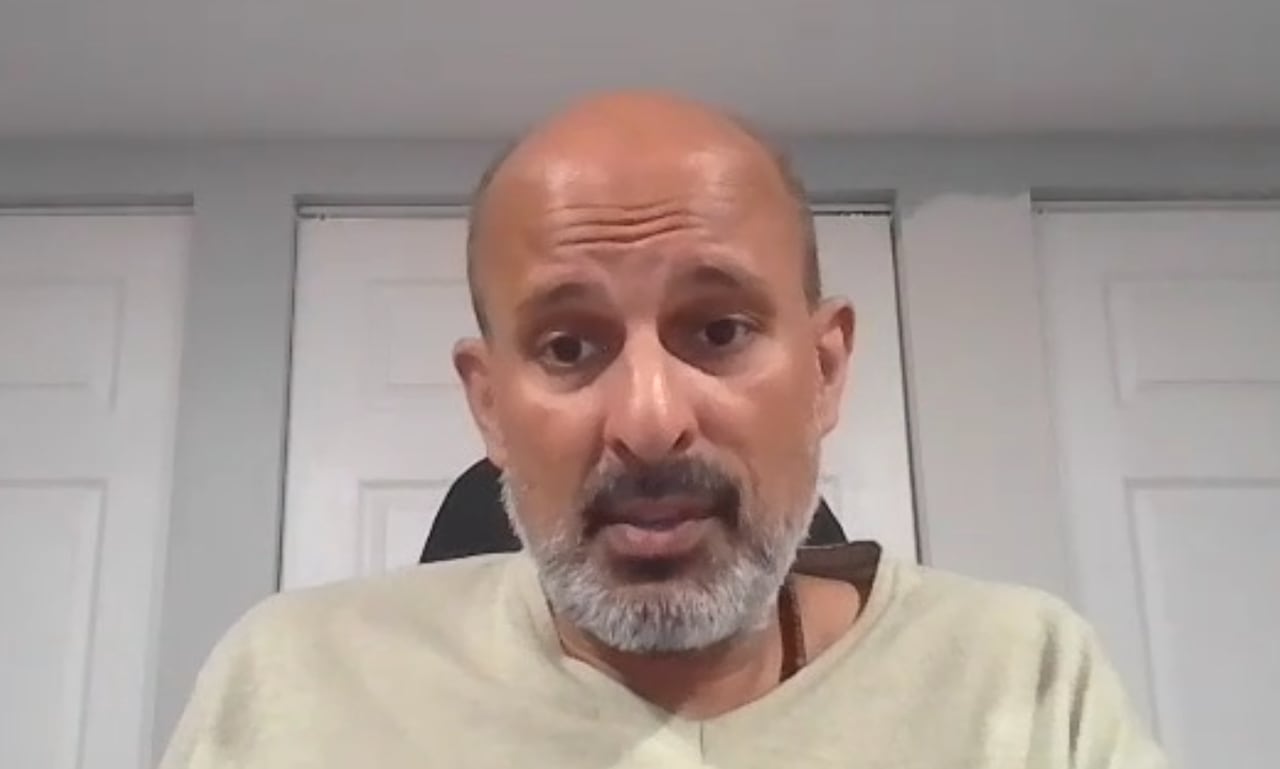
Aaloak Jaswal, head of innovation at the University of New Brunswick’s Data Science and AI Research Institute, highlighted that AI has enabled the creation of realistic images without advanced technical knowledge. (CBC/Zoom)
Jaswal also warned that repeated exposure to misinformation and persuasive AI-generated visuals poses a risk.
During actual public safety concerns, he mentioned, official sources aim to deliver timely and accurate information. However, if individuals begin to lose trust in what they see and hear, they may disregard authentic warnings or make choices based on unverified data.
“Nature introduces enough uncertainty during an emergency, and we should not compound that with artificial uncertainty,” Jaswal remarked. “At its core, this is not merely a technology issue; it’s fundamentally a trust issue.”
Professor van der Linden noted that people may also adopt a “better safe than sorry” mindset regarding news during emergencies.
While he acknowledged that this approach might be sensible in certain situations, the downside of frequent online fearmongering could lead to adverse outcomes.
For instance, he cautioned that if a legitimate environmental or public health crisis arises, individuals may doubt it due to previous experiences where misinformation obscured the truth.
“The challenge is that people become uncertain about what to believe,” van der Linden stated.
He suggested that one of the most effective strategies is “pre-bunking,” which involves alerting friends, neighbors, and family in advance about the potential for misinformation.
“You need to … say, ‘Look, misinformation is spreading, here’s what official sources are saying, don’t be deceived,'” van der Linden urged.
“This is a public service that everyone can contribute to, fostering a healthy information ecosystem and ensuring community safety.”

