
Joshua Kutryk, who spent his childhood on a cattle ranch in Fort Saskatchewan, Alberta, always envisioned traveling to space, though he never believed it would actually come true.
However, just a few months following Artemis II’s lunar flyby, the 44-year-old astronaut is gearing up for a mission to the International Space Station that may result in significant medical advancements.
Kutryk is among the four astronauts selected for NASA’s SpaceX Crew 13 mission.
He will be joined by NASA’s Jessica Watkins and Luke Delaney, along with Sergey Teteryatnikov, a cosmonaut from Roscosmos. This mission marks Watkins’ return to the space station, having previously spent 170 days on the ISS in 2022.
The crew is set to spend six months on the station to carry out various experiments and perform maintenance tasks.
The SpaceX Dragon spacecraft, which will transport the crew, is scheduled to launch from NASA’s Kennedy Space Center in Florida on September 12.
“Being involved as a Canadian is something truly unique and special,” Kutryk remarked.
“Canada’s space program holds a special significance and we achieve so much through it.”
This mission features Canadian-led research examining how space travel and microgravity impact human health.
According to Kutryk, much of the science funded by Canada could have meaningful implications for upcoming space missions, but he also noted that some of these studies could enhance medical practices on Earth.
The experiments might contribute to developing treatments for conditions like heart disease and osteoporosis, as the effects of radiation and microgravity influence cardiovascular health and bone density, Kutryk elaborated.
Conducting medical research in space can be advantageous since the human body ages more rapidly in that setting, he mentioned during a press conference.
“They are using the space environment and my body as a case study to analyze issues that all humans eventually face on Earth,” Kutryk stated.
Mathieu Caron, the director of the astronauts’ office at the Canadian Space Agency, remarked that space life sciences “has evolved into a unique area for Canada.”
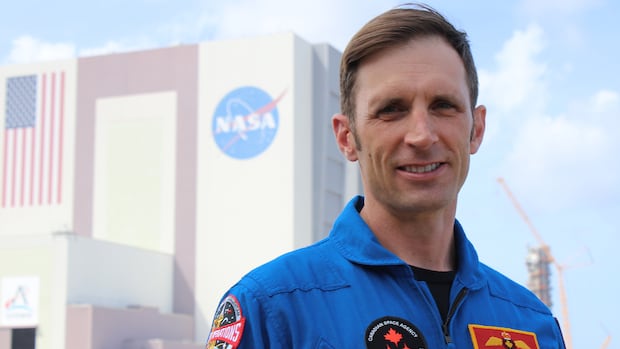
Joshua Kutryk is set to be the next Canadian astronaut in space and the first to participate in a joint NASA-SpaceX mission. Kutryk is set to leave for the International Space Station on Sept. 12.
The crew will also perform maintenance tasks on the station, which includes the Canadian-engineered servicing system known as Canadarm2.
Kutryk will leverage his robotics expertise during the mission, Caron noted.
He is the fourth Canadian astronaut to engage in a long-duration mission aboard the International Space Station.
Space educator Trevor Kjorlien from Montreal indicated that with NASA planning to retire the station by 2030, Kutryk might be among the last Canadians to reside on it.
“This is a prime chance for many Canadians to witness the station over the next six months after he launches, as it may be the last time they see it with a Canadian onboard,” he commented.
Kutryk expressed his hope that both the recent Artemis II and the upcoming Crew 13 missions will inspire young Canadians to pursue careers in technical fields. He emphasized that Canada has played a significant role in space exploration alongside NASA by participating in both missions.
“I hope that when young individuals observe this, they recognize that we are at a truly pivotal moment,” he stated.
“The future of space exploration for Canada is exceptionally bright if one chooses to pursue it. There will be numerous opportunities for aspiring Canadian astronauts, engineers, and scientists — far more than what I had while growing up.”
After years of both physical and mental preparation for this mission, Kutryk and his team are excited and ready for their imminent launch in just a few weeks.

