
Interested in profiting from prediction markets as they enter the Canadian market? Recent studies indicate that the odds may not be in your favor.
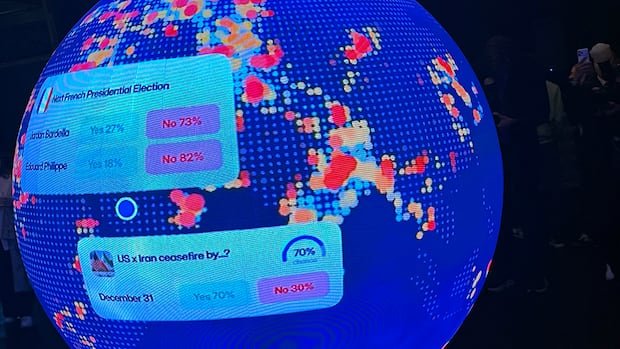
Prediction platforms such as Polymarket and Kalshi enable users to bet on the likelihood of real-world occurrences through trading contracts. In Canada, these platforms will focus on events related to economic indicators, financial markets, and climate patterns. Examples of current contracts on Polymarket include questions like “Will there be a Bank of Canada rate hike in 2026?” and “Will any month in 2026 be the hottest on record?”
Unlike traditional gambling venues, prediction markets do not have a house to play against. Instead, users compete against each other, with the platforms generating revenue through small transaction fees for each bet placed.
A recent research paper by scholars from Yale University and London Business School reveals that only a small percentage, about three percent, of Polymarket users labeled as “skilled traders” consistently make profits and accurate predictions. The study notes that a larger group of losing traders essentially fund the winnings of the skilled minority.
With the imminent expansion of these markets into Canada through Wealthsimple’s collaboration with Kalshi, experts advise Canadians to be aware of their competition.
“You need to have a high level of sophistication,” stated Roberto Gómez-Cram, co-author of the paper and assistant professor of finance at the London Business School, in an interview with CBC News.
“If you are not well-prepared, you are likely to face significant challenges.”
Majority of Traders Enable Success of a Few
The research paper, not yet peer-reviewed, analyzes data from Polymarket, with a sample size encompassing $13.76 billion US in trading volume across 1.72 million accounts.
It suggests that nearly 70 percent of the trading volume originates from less skilled traders, indicating that the winners in the market largely benefit from the mistakes of the majority.
Due to the absence of a traditional house, the system relies on substantial trading volume to operate efficiently. The more users engage in contract positions, the more capital flows into the platform, resulting in increased profits for skilled traders.
Market operators argue that substantial participation in an event’s outcome fosters a “wisdom of the crowd” effect, leading to accurate predictions. However, the researchers contend that this accuracy primarily stems from a small group of adept traders.

