
On Tuesday, numerous regions across Canada experienced intense heat, prompting Environment Canada to issue weather alerts regarding poor air quality, extreme heat, and thunderstorms.
Heat warnings were in effect for all areas except the northernmost parts of Ontario, with temperatures reaching the mid to high 30s Celsius, and humidity levels making it feel like the mid-40s.
Warnings regarding heat or air quality were also issued in the west, affecting Manitoba, Saskatchewan, Alberta, and the Northwest Territories.
In the east, Environment Canada cautioned about the possibility of dangerous storms in Quebec and New Brunswick. An orange tornado watch was issued for the area between Montreal and Quebec City, including Drummondville, Trois-Rivières, and Shawinigan, though it was later lifted.
The primary reason for these warnings is a large high-pressure system centered in the United States that has “created heat advisories and warnings across the Upper Plains states, parts of Manitoba, throughout Ontario, the Great Lakes states, and even into Quebec,” according to Environment Canada meteorologist Geoff Coulson on Monday.
“It’s a broad system that is bringing significantly above-average temperatures.”
Several cities in southern Ontario, including Toronto, were anticipated to set records for daily heat.
The highest temperature ever recorded on July 14 at Toronto’s Pearson airport was 36.7 C in 1995, with a humidex that felt like 50 C, as noted on Environment Canada’s website.
On Tuesday afternoon, temperatures in downtown Toronto exceeded that record, reaching 36.8 C at 4 p.m. ET, with a peak of 37.3 C reported at 5 p.m. ET.

A person uses an umbrella to shield themselves from the sun as temperatures rise in Toronto on Monday. (Chris Young/The Canadian Press)
Much of northern Ontario, from Kenora and Thunder Bay to Fort Hope and Timmins, was also placed under a serious orange heat warning, while other areas were under lower-level yellow warnings.
In northern Ontario, the thresholds for issuing heat warnings are lower, based on historical averages and potential impacts; for example, a humidex of 36 in the north compared to 40 in the south.
Staying Comfortable
Across the nation, municipalities, including Ottawa, have established cooling centers and pools for residents to escape the heat.
Some businesses have opted to pause operations.
“We decided to close for the next two days,” stated Sarah Bowen, social media manager for the Heart and Soul Café in Ottawa, on Tuesday.
“Our main concern is the safety of our staff. The kitchen temperature can become unmanageable, even with air conditioning and fans running.”
Environment Canada advises people to be vigilant for early signs of heat exhaustion, which may include headache, nausea, dizziness, thirst, dark urine, and extreme fatigue.
If anyone exhibits symptoms of heat stroke, they should call 911. Symptoms include red, hot skin, nausea, dizziness, confusion, and altered consciousness.
-
Withering heat grips eastern Ontario, western Quebec
-
Severe thunderstorm watch, tornado risk issued for much of southern Quebec
The agency also encourages the public to activate air conditioning, stay hydrated, keep blinds closed, and reduce sun exposure. It is recommended that residents wear lightweight, light-colored, and loose-fitting clothing, along with hats.
Air Quality Concerns
In addition to the heat, some regions are facing smoke from forest fires.
“We are experiencing significant wildfire activity, particularly west of Thunder Bay,” Coulson stated. “With winds coming from the west, plumes of wildfire smoke are moving east toward the Thunder Bay region.”
“This can result in locally poor air quality readings in areas affected by the wildfire smoke,” he explained. “It’s a double challenge; we are dealing with heat and humidity from the extensive weather system, compounded by local concerns about poor air quality from wildfire smoke.”
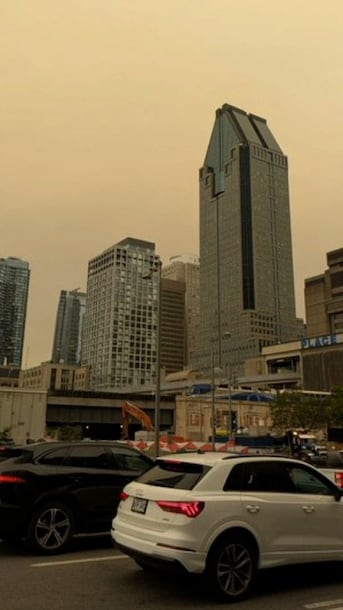
The unusual color is a clear indication that wildfire smoke is present in the atmosphere, primarily due to fires in northern Quebec and other regions. Much of the southern and western parts of the province are currently under warnings for severe thunderstorms and potential tornadoes.
An emergency room physician in Yellowknife is advising residents of the N.W.T. to frequently monitor local air quality throughout wildfire season and to consider wearing face masks on particularly smoky days.
Dr. Courtney Howard suggests that well-fitted N95 masks can filter out about 90 percent of fine particulate matter, making them much more effective than surgical masks, especially during prolonged exposure to wildfire smoke.
Is this weather normal? Track climate changes in your area here.

