
Throughout Manitoba, individuals donned red attire to march, sing, and advocate for justice in remembrance of missing and murdered Indigenous women and girls as Canada observed Red Dress Day on Tuesday.
This nationwide day of recognition has been established more than 15 years after Jaime Black, a Métis artist from Manitoba, devised an art installation featuring red dresses suspended in public areas, symbolizing Indigenous women and girls who are either missing or have been slain.
Over 100 individuals convened outside the Winnipeg Law Courts on Tuesday morning to sing, drum, and smudge before proceeding to The Forks.
Krista Fox, an advocate from Saskatchewan for missing and murdered Indigenous women and girls, expressed her presence at the event to stand in solidarity with the family of Ashley Morin, a 31-year-old Cree woman who has been missing since 2018 from North Battleford, Sask.
“We have not yet been able to bring her home or find those accountable,” Fox shared with Radio-Canada outside the courthouse on Tuesday. Police declared in 2019 that they suspect Morin was a homicide victim.
Fox also participated in the march to honor her 14-year-old grandson, who was murdered in December 2020.
According to Fox, hanging a red dress in a window or partaking in a Red Dress Day march carries significant meaning for families enduring loss.
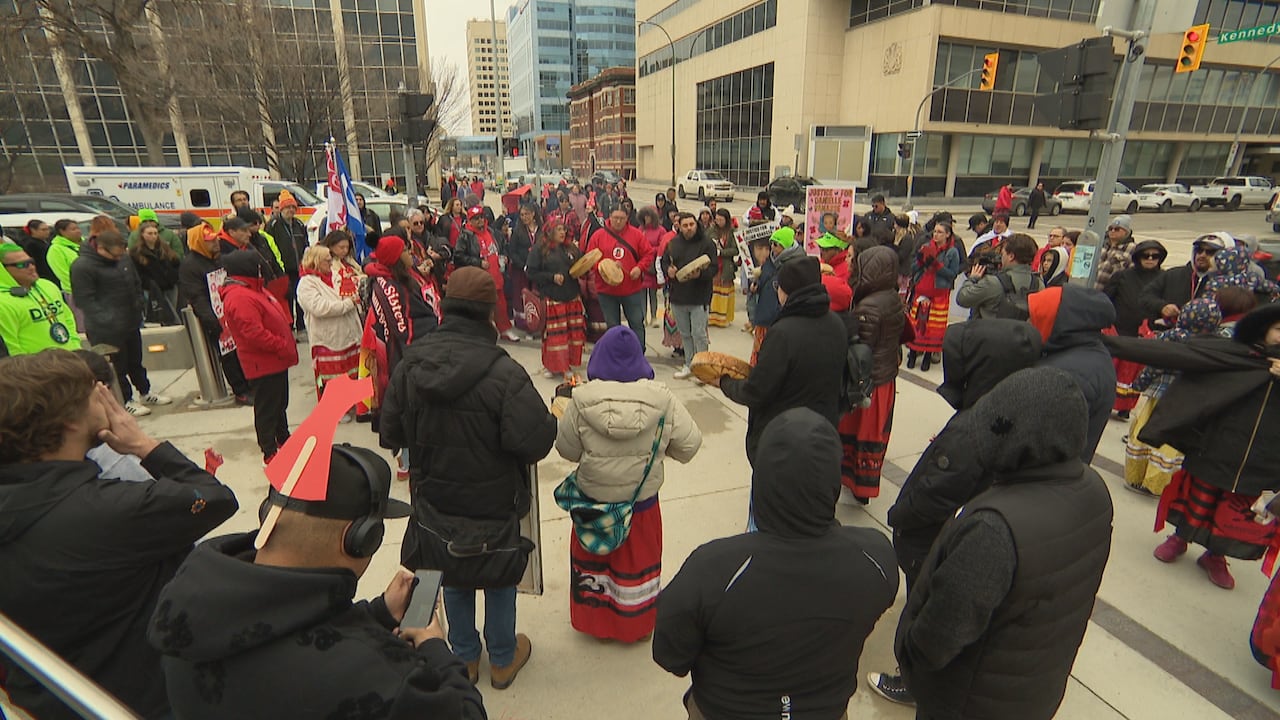
More than 100 individuals gathered outside the Winnipeg Law Courts to sing, drum, and smudge before marching to The Forks on Tuesday morning. (Radio-Canada)
“For us, Red Dress Day is every single day,” she stated.
“These topics are not ones you can easily discuss in a grocery store or with a friend over coffee.”
The gathering followed the first-degree murder conviction of Josh Benoit, 24, for the killing of Mackaylah Gerard-Roussin, 20, at the Winnipeg Law Courts on Tuesday morning.
The body of the First Nations woman was discovered on a secluded ATV trail south of Woodridge, Man., days after her disappearance in 2022.
During the march, participants held a large banner displaying the young woman’s image.
Kirby Gerard, Gerard-Roussin’s father, shared the emotional toll of losing his daughter, particularly through violence.
“It has been a long journey just to achieve this verdict,” he told the assembly at Oodena Circle at The Forks.
Relatives of other Indigenous women and girls who lost their lives in Manitoba also addressed the crowd, including the father of Eishia Hudson, the 16-year-old who was fatally shot by Winnipeg police in 2020.
An inquest into the teen’s death has been ongoing at the Winnipeg Law Courts since April.
“Today was a positive day,” William Hudson told the audience, referencing Benoit’s conviction. “We hope for this kind of justice for all families.”
The father of Ashlee Shingoose, the previously unidentified victim of Winnipeg serial killer Jeremy Skibicki, also spoke. The province is currently undertaking a search for Ashlee Shingoose’s remains at Winnipeg’s Brady Road landfill.
-
MMIWG2S+ lives and legacy honoured by loved ones at annual Winnipeg memorial march
-
NDP’s Leah Gazan calls MMIWG2SLGBTQQIA+ critics ‘bigots’
“We must keep faith in our prayers that we will bring our daughters home,” Shingoose expressed at The Forks. “We will achieve this.”
Melissa Robinson, who leads the missing and murdered First Nations Peoples unit at the Assembly of Manitoba Chiefs, described the day as challenging.
“It’s heartening to see such a large turnout to support families affected and to recognize that they are not alone in this struggle,” she shared with Radio-Canada at The Forks.
She encouraged everyone to take a moment on Tuesday to “reflect on these families and the grief they endure daily.”
“For most, today is just another day, but for these families, this is a constant reality.”
NDP Housing Minister Bernadette Smith became emotional in the legislative chamber while commemorating her late stepmother and advocate Brenda Osborne. Osborne was the mother of Smith’s sister Claudette Osborne, who disappeared in 2008.
Tory MLA Jodie Byram and NDP Families Minister Nahanni used their private member statements to honour families and highlight systemic failures.
“Indigenous women are sacred. We hold immense power. We deserve safety from male violence, and on Red Dress Day, our government reaffirms its pledge to end violence against Indigenous women, girls, and two-spirit individuals,” Fontaine stated.
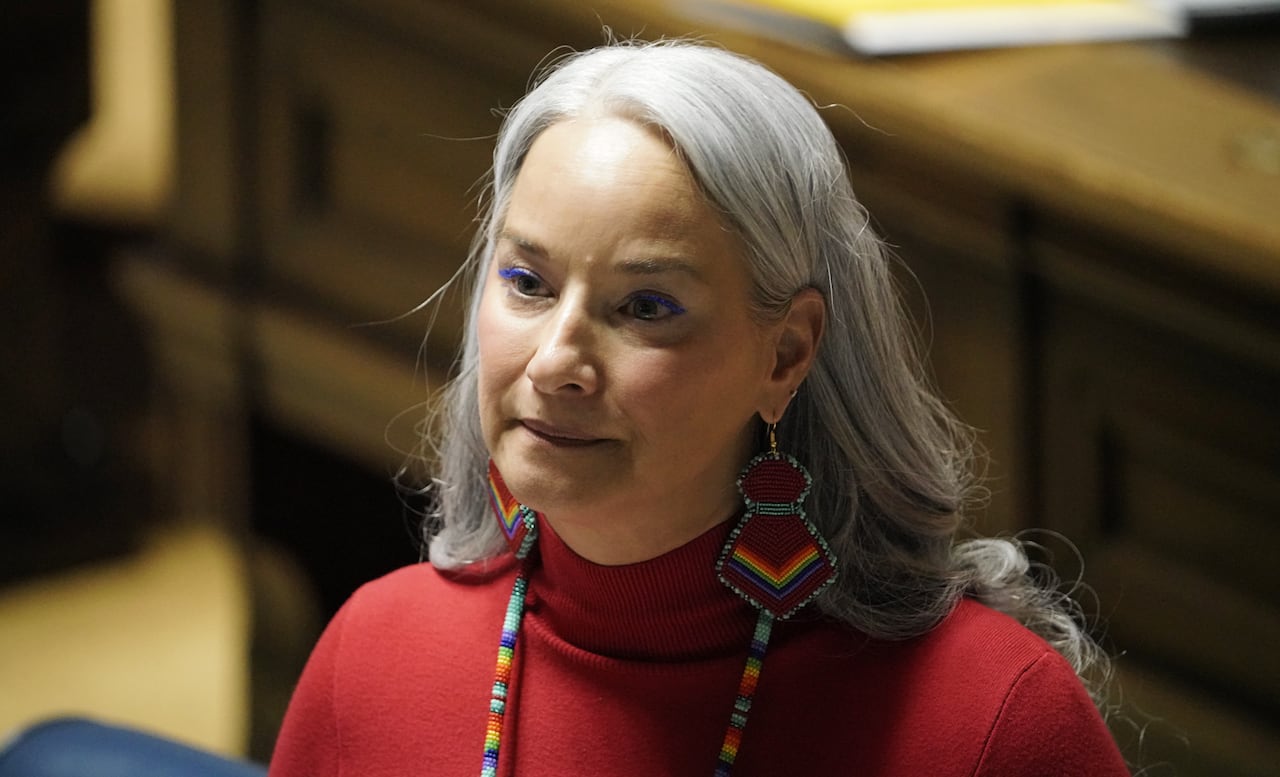
Manitoba Families Minister Nahanni Fontaine speaks at the legislature as part of Red Dress Day acknowledgments. (Bryce Hoye/CBC)
In the largest city of southwestern Manitoba, over 100 individuals gathered at Brandon University to commemorate the day.
Michelle Klyne, advocacy co-ordinator for Brandon Pride, noted that participants assembled to help end the ongoing trauma and suffering within Indigenous communities.
“We need allies to stand with us in solidarity to prevent victimization and abductions,” she stated. “This is genocide.”
Klyne, an Indigenous two-spirit knowledge keeper, has been engaged in this battle for two decades after experiencing trafficking at the age of 16.
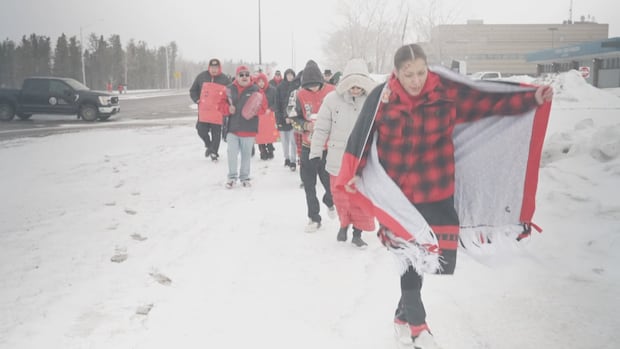
Communities across Manitoba commemorated Red Dress Day on Tuesday, honouring missing and murdered Indigenous women and girls and paying tribute to lost loved ones.
“My younger self is eager for change,” she remarked. “I aim to assist the youth grappling with numerous challenges in the community.”
Valerie Sandy, one of the event’s co-organizers, expressed her hope that the march would raise awareness and educate others about the real individuals suffering from these issues.
“These are family members, loved ones who are going missing, being murdered, and the grief, pain, and trauma that follow are immense,” Sandy noted. “This impacts the entire community.”
The march concluded at Princess Park in downtown with a special jingle dress dance, a ceremony associated with healing.
Sandy hopes that attendees felt the love as they observed the dance, which was meant to convey the message that they are not alone.
-
Indigenous-led Red Dress Alert program must be implemented in Manitoba ‘without delay’: report
-
‘Let her come home,’ Manitoba mother says, as daughter’s disappearance marks a decade
“I remain very optimistic for our people and hopeful about bringing these issues to the forefront,” Sandy expressed. “We must continue to push forward, utilizing our voices and prayers.”
In Thompson, the largest northern city in Manitoba, participants smudged, prayed, and tied red ribbons to the railings of the Miles Hart Bridge in memory of their loved ones before proceeding to a memorial on Mystery Lake Road for a ceremony.
Lynda Neckoway, an elder from Fox Lake Cree Nation in northeastern Manitoba, revealed that her sister, Millie Flett, was last seen in Winnipeg in 2010 following a gathering for residential school survivors. Her family has not heard from her since.
‘More funerals than weddings’
Neckoway described her sister as a vibrant, beautiful soul who enjoyed interacting with others and was involved in making and selling jewelry.
“We rarely received assistance from the police. What infuriated me was that during one of the early interviews, the police asked me if I had killed my sister. I was taken aback,” she recalled.
Felicia Lobster, who lost her sister in 2008, shared her insights on the impact of violence against women on communities. Now, she engages with young people to guide them towards a better future.
-
‘Our stories matter’: Website honours lives of missing and murdered Indigenous women and girls across Manitoba
-
Video
Red Dress Day artist says feds not taking enough action on MMIWG
“We should not have to hold more funerals than weddings,” she stated.
Lobster participated in the Thompson ceremony, dancing in full regalia, with a red handprint — a symbol for missing and murdered Indigenous women — sewn onto her shawl.
She aims to utilize dance to assist a new generation, even gifting her own shawls to young dancers.
“I was once an at-risk youth, and these programs supported me. I aspire to give back and help those involved in these initiatives,” she expressed.

